
Mindful leadership is hard. This is a fact many people don’t talk about enough. On one hand, you are expected to drive the momentum of the business — to make decisions, create direction, deliver results. On the other hand, you are responsible for managing the emotions, energy, and inner worlds of the people in your team.
I often tell my team that in the office, I put on my “therapist hat.” My first job is to balance the emotions in the room — to stabilise the difficult days, uplift the tired hearts, and quietly hold space for the people who need it. My real office work only begins when I get home.
Naturally, moving through the world this way means becoming a sponge in the leadership dynamic. I absorb the emotions of my team — the worries, the frustrations, the hopes, the highs — all day long. Sometimes I carry more than I realise. Sometimes I carry more than I admit.
That’s precisely the issue here, isn’t it? We live in constant motion, yet that motion is rarely for ourselves. Our days are filled with doing, helping, fixing, solving — for everyone except the person we see in the mirror.
In my previous role, I was attached to a Chinese multinational tech company. It remains one of the best organisations I have ever worked for, and it shaped the future of my career more than any other experience. But it was also one of the toughest chapters of my life. The learning curve was impossibly steep, the work structures complex, and the pressure relentless. I pushed myself to succeed, and I did — but the cost began to show.
Always on the go, always plugged in, always performing at maximum output, my body eventually began to break down. I started falling sick often, especially with debilitating migraines. I tried everything — medication, lifestyle changes, medical scans — but nothing eased the frequency or intensity of the pain.
Eventually, I reached a point where I knew I needed to stop. Not pause. Stop.
So I took a two-week break and escaped to Eastern Europe.
I drifted through Prague and Budapest at first, but it was the tiny, quiet capital of Slovakia — Bratislava — that changed me. I stayed there much longer than planned. I woke up each day with no itinerary. On impulse, I would join a wine-tasting tour. On other days, I’d sit in the old town with an ice-cold dark beer, watching people go about their lives. And some days, I didn’t even leave the Airbnb. I read, slept, journaled, and let my brain unclench for the first time in years.
And slowly, something shifted.
The migraines eased.
My nervous system calmed.
I felt myself again.
By the time I returned, I wasn’t just rested — I was restored.
That trip became the beginning of my intentional slow travel journey. What started as a want quickly became a need — a survival strategy, even.
Later, as I transitioned into a senior leadership role in my next organisation, responsible for the livelihood and well-being of more than 70 team members, I realised I needed slow travel more than ever. During the busiest, most high-pressure periods, I took deliberate slow trips so I could think better and think clearer. These moments of stillness weren’t indulgent — they were crucial for mindful leadership.
And that’s when I learned one of my most important leadership lessons from travel:
Slowness creates space for empathy.
Slowness makes you a gentler, more present leader.
Slowness helps you lead people, not just manage them.
My journey with slow travel for leaders has shaped the way I run my team today — with more listening, more compassion, and more awareness of the emotional temperature in the room. It taught me that leadership isn’t about how fast you move, but about how intentionally you choose to move. That’s what mindful leadership is all about – the intention.
What Slow Living for Mindful Leadership Really Means?
The truth is – I didn’t start out this way.
Once upon a time, I was the same brash, emotionally driven manager who carried the weight of the world on her shoulders. I reacted fast, worked fast, thought fast, and burned out fast. And like many leaders who rise quickly through the ranks, I didn’t have the luxury of a mentor early in my career. I learned through mistakes, pressure, and survival.
It wasn’t until much later — under my ex-boss, Kevin — that I finally understood what it meant to slow down with purpose. He showed me that sometimes the most powerful thing a leader can do is step back, breathe, and look at a situation through a softer, clearer lens. Kevin taught me empathy, the kind that transforms someone from being just a “boss” into a truly gentle leader.
That was my first taste of what mindful leadership and slow living for professionals actually means.
It’s not laziness. It’s not idleness. It’s certainly not about doing less work.
Slow living, in a mindful leadership context, is:
- Intentionality — responding instead of reacting
- Presence — being fully there for your people
- Emotional regulation — leading from stability instead of volatility
- Clarity — making decisions from a grounded mind instead of a frantic one
And this is where my practice of slow living collided with my practice of travel. Because the more I embraced slow travel for leaders, the more I realised how deeply connected both philosophies were. When you’re walking slowly through a quiet city, or sitting alone in a café far from home, the noise inside you quiets too. Your mind becomes sharper. Your heart softens. Your perspective expands.
Those quiet pockets of time became some of my greatest leadership lessons from travel.
They taught me that clarity comes when urgency fades. Creativity emerges when your nervous system is calm. And empathy grows when you give yourself space to feel again.
Leaders today need slowness more than ever — not as a luxury, but as a leadership tool. In a world that demands constant speed, fast responses, instant results, and endless emotional labor, moving gently is not weakness. It is a strategy. It is strength. It is sustainability.
Slow living doesn’t make you less professional. It makes you a leader who sees better, decides better, and leads better.
How Slow Travel Amplifies Slow Living For Leaders
Some of my best ideas have arrived while I was traveling. Mini Explorer — my children’s travel activity series — was born on a trip. So was the idea for this travel-and-leadership site. It’s almost funny how, when I’m at work, my mind is locked into a singular tunnel: the next problem, the next deadline, the next fire to put out. I move from meeting to meeting, constantly absorbing the emotions and anxieties of my team. Decisions pile up. Stress accumulates. And as a result, creative thinking becomes impossible.
This is a reality many emerging leaders face.Anxiety breaking them down before a big pitch. Tears in the bathroom from pressure. Sudden medical leaves taken as a coping mechanism. People think this is just the way “leaders” are supposed to live — but it isn’t sustainable. It isn’t healthy. And it certainly isn’t the foundation of mindful leadership.
What I’ve learned is that slow travel for leaders doesn’t always require boarding a plane. Sometimes, the distance you need is not geographical — it’s emotional. A staycation in your own city, a morning spent in nature, or a weekend camping by a quiet river can be enough to break familiar stress patterns. These small intentional pauses give you a chance to slow down, observe, and think in ways that simply aren’t possible in the noise of everyday work.
For me, it’s being surrounded by trees, listening to the river move gently, sipping a hot cup of coffee with absolutely nothing urgent waiting for me. It is rest without guilt — space without pressure. This is the difference between escaping life and restoring yourself. And this distinction is the core of slow living for professionals who carry heavy emotional and strategic responsibilities.
One of my earliest and most profound leadership lessons from travel happened in 2014 in Kathmandu, Nepal. My cousin and I were traveling toward Nagarkot, where we would stay for a few nights to wake up to the Himalayas. Just before arriving, the sun began to set. I asked my guide to stop, and the three of us sat by the edge of a hill for two full hours — watching the sky shift to orange hues, with the Himalayan range glowing quietly in the distance.
To this day, that moment remains one of my favourite travel memories.
Because in that stillness, I learned something I carry into gentle leadership even now:
When you slow down long enough to be fully present, the world reveals things you were too busy to notice. Answers show up. Clarity takes shape. Your inner voice becomes audible again.
Slow travel amplifies slow living and in turn encourages mindful leadership because it forces you out of the patterns that keep you stuck. It places you into environments where your mind can soften, your body can breathe, and your spirit can return to its natural intelligence.
And once you experience that kind of restoration, you lead differently.
Mindful Leadership Lessons From Travel
If there is one thing travel has taught me again and again, it’s that the world becomes a mirror when you slow down long enough to look into it. The road reveals truths you don’t always see in a meeting room, a Zoom call, or a performance review. It softens you, stretches you, humbles you, and shows you exactly who you are as a leader — not through textbooks or frameworks, but through moments of challenge, discomfort, awe, and connection.
These are the leadership lessons from travel that no workshop could have taught me. Lessons shaped by mountains, silence, strangers-turned-guides, and the unexpected tenderness of people you meet along the way. Sometimes the world teaches you through beauty; sometimes through difficulty; often through both at the same time.
One of the earliest lessons came to me on a winter day in 2015, high up on the Great Wall of China. When I was in Beijing during the winter of 2015, I decided to brave the cold and hike the Great Wall of China. Let me clarify — not the tourist-friendly section that most people visit, but the unrestored part of the Great Wall. A 10KM loop that took us a full seven hours to complete.
It remains the single toughest hike I have ever done.
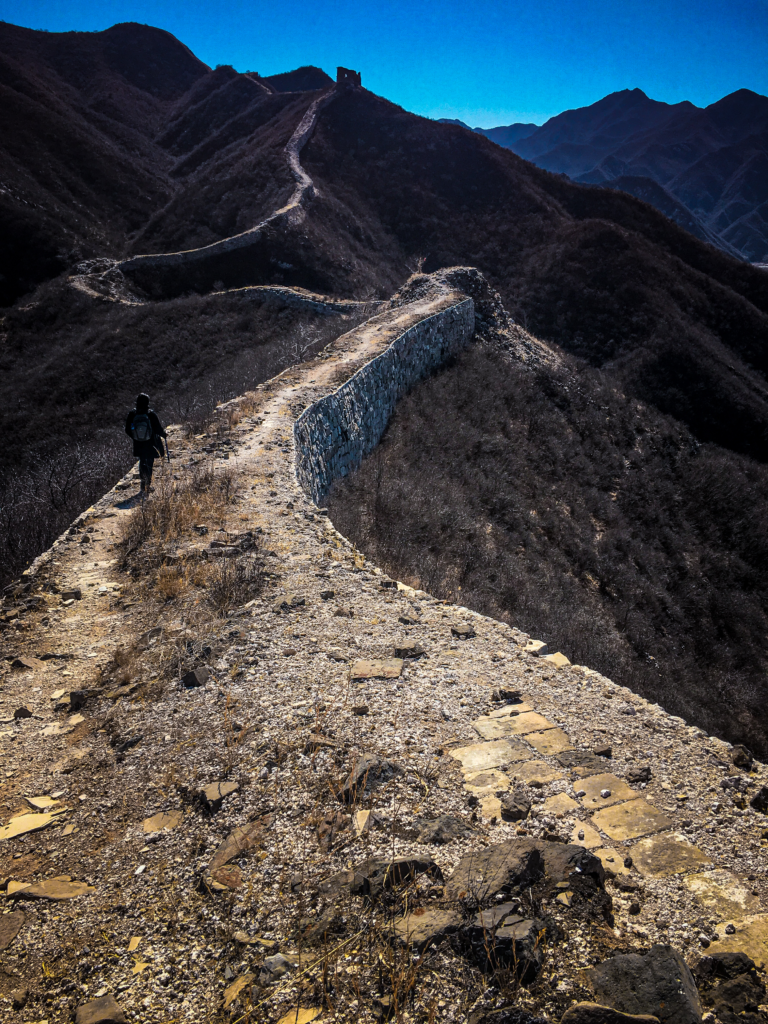
The stones were slippery. There were no railings, nothing to hold on to. Some steps were so steep and crumbling that every upward push felt like a small battle.
My cousin and I were definitely not the fittest two girls in the group, so naturally, we were hiking all the way at the back — far from the energetic first two hikers who bounded ahead effortlessly.
But our guide never once left us behind. He stayed with us step by step, offering small encouragements and reminding us of the warm food waiting at the end of the trail. He set a gentle pace, slowed down when we did, and matched his breath to ours. He made us feel seen, not embarrassed. Supported, not burdensome.
When we eventually arrived at the restaurant — predictably the last ones to reach — the entire hiking group cheered loudly for us. That meal tasted like the most delicious food we had ever eaten, not because it was extraordinary, but because we felt safe, supported, and celebrated.
And that day, I learned one of my earliest and most meaningful leadership lessons from travel:
People don’t remember how difficult the journey was. They remember how supported they felt while walking it.
Support turns struggle into accomplishment. It transforms fear into pride. It makes people willing to try again, even when they start at the back.
A leader’s role is not to race ahead — it’s to walk beside the slowest hiker and help them believe they can finish.
I was reminded of this years later with a young copywriter in my team — a talented girl named Mag. When I inherited the team from my predecessors, she was already placed under a senior member’s supervision. But after reviewing her work, I saw something more in her. She wasn’t just capable of writing; she had the potential to think, create, and lead.
So I started giving her small challenges.
I made time to speak with her.
I checked in.
I listened.
I nudged her gently toward growth.
None of it felt extraordinary to me — just the basic duty of a leader who believes in someone.
But one day, during a team-building session, she handed me a handwritten note. What she wrote brought tears to my eyes. I didn’t realise that such simple, intentional actions on my part — a few conversations, a bit of encouragement, a little belief — had meant so much to her.
That moment reminded me that the support we offer often feels small to us, but it can change the entire path for someone else. And sometimes, leadership is exactly that: quiet encouragement, steady presence, and the willingness to walk beside someone until they find their own pace.
On my first trip to Busan, I assumed it would feel similar to Seoul — modern, familiar, and easy enough to navigate. So it never crossed my mind to prepare the Hangul name of my hotel. I simply hopped into a taxi, confident I could manage with basic English and my broken Korean.
But the universe had other plans.
My taxi driver was an elderly man who spoke zero English.
I repeated the English name of my hotel several times.
He stared back blankly.
After the third attempt, frustration rose in both of us.
For a moment, we were two strangers stuck in the same car but living in two different worlds.
Finally, I searched for a nearby landmark with a Korean name, pronounced it the best I could, and he immediately understood. Twenty minutes of stress suddenly melted into relief as we finally made our way to the destination.
From that day onward, I made it a habit to always prepare the Hangul version of any location I needed to go. Sometimes I used it. Sometimes I didn’t. But that small act of preparation became a gentle reminder of a bigger truth.
There is no one-size-fits-all approach in mindful leadership — just like there is no one universal language for travel.
Every person in a team “speaks” differently:
Different motivations,
Different strengths,
Different insecurities,
Different ways of understanding instructions.
What works beautifully for an experienced employee may overwhelm a fresh graduate. What energises a Gen Z team member may fall flat with someone who’s been in the workforce for 20 years.
And expecting everyone to learn, grow, and thrive in the same way is the quickest way to set someone up for failure.
A good leader recognises this.
A gentle leader honours it.
Allowing a person to thrive in an environment that amplifies their strengths — while guiding them to grow gently in areas of weakness — is the real recipe for gentle leadership.
This is one of the most important leadership lessons from travel that stayed with me long after that taxi ride in Busan.
Leading gently in a world that moves too fast
If there’s one truth I’ve learned from years of traveling, leading, and growing, it’s this:
You don’t have to move fast to be effective.
You don’t have to push hard to be strong.
And you don’t have to carry everything alone to be a good leader.
Slow living and slow travel have shown me again and again that clarity comes when the noise fades, empathy grows when you pause long enough to feel, and leadership becomes most powerful when it is rooted in gentleness, not force.
And don’t get me wrong — I’m not asking you to be soft or gentle in every communication. Leadership will always require moments of firmness. There will be days where you need to be stern, decisive, and even harsh if the situation calls for it. Your words may have to be sharp, but your intention does not need to be.
You can communicate firmly while still leading with empathy.
You can make hard decisions while still moving gently.
So if you’re tired, overwhelmed, or simply searching for a better way to lead — try slowing down.
Create space.
Move with intention.
Let your days breathe a little.
You might be surprised by how differently the world responds when you do.
When you move gently, life meets you gently.
May you give yourself permission to breathe again.

More slow living and mindful leadership reflections are coming soon.
